Code Style. Python
Use this page to configure formatting options for Python files. When you change these settings, the Preview pane shows how this will affect your code.
Tabs and Indents
Use tab character
If this checkbox is selected, tab characters are used:
On pressing the Tab key
For code reformatting
When the checkbox is cleared, PyCharm uses spaces instead of tabs.
If this checkbox is selected, the part of indentation defined by the nesting of code blocks, is made of the tabs and (if necessary) spaces, while the part of indentation defined by the alignment is made only of spaces.
If this checkbox is cleared, only tabs are used. This means that a group of spaces that fits the specified tab size is automatically replaced with a tab, which may result in breaking fine alignment.
The Smart tabs checkbox is available if the Use tab character checkbox is selected.
In this field, specify the number of spaces included in a tab.
In this field, specify the number of spaces to be inserted for each indent level.
In this field, specify the number of spaces to be inserted between the elements of an array, in expressions, method declarations and method calls.
Keep indents on empty lines
If this checkbox is selected, PyCharm will keep indents on the empty lines as if they contained some code.
If this checkbox is cleared, PyCharm will delete the tab characters and spaces.
Spaces
Use this tab to specify where you want spaces in your code. To have PyCharm automatically insert a space at a location, select the checkbox next to this location in the list. The results are displayed in the preview pane.
Wrapping and Braces
In this tab, customize the code style options, which PyCharm will apply on reformatting the source code. The left-hand pane contains the list of exceptions ( Keep when reformatting ), and placement and alignment options for the various code constructs (lists, statements, operations, annotations, and so on) The right-hand pane shows the preview.
Alignment takes precedence over indentation options.
Visual guides
Use the Visual guides field to specify multiple right margins. You can leave a default value or enter the number of spaces for your margin. If you want to specify several margins, enter numbers separated by comma.
Keep when reformatting
Use the checkboxes to configure exceptions that PyCharm will make when reformatting the source code. For example, by default, the Line breaks checkbox is selected. If your code contains lines that are shorter than a standard convention, you can convert them by disabling the Line breaks checkbox before you reformat the source code.
Ensure right margin is not exceeded
If this checkbox is selected, the formatter will do its best to avoid having document lines exceeding the right margin. This option takes precedence over the Do not wrap wrapping style.
Method declaration parameters
Click the field next to the setting to see the available options:
Do not wrap : when this option is selected, no special wrapping style is applied.
With this option selected, the nested alignment and braces settings are ignored.
Wrap if long : select this option to have lines going beyond the right margin wrapped with proper indentation.
Wrap always : select this option to have all elements in lists wrapped, so that there is one element per line with proper indentation.
Chop down if long : select this option to have elements in lists that go beyond the right margin wrapped, so that there is one element per line with proper indentation.
Align when multiline
If this checkbox is selected, a code construct starts at the same column on each next line. Otherwise, the position of a code construct is determined by the current indentation level.
Select this checkbox to have the code after the specified character moved to a new line.
Place ‘(‘ on the line
Select this option to have the opening brace placed at the beginning of the line after the declaration line.
Method call arguments
Click the field next to the setting to see the available options:
Do not wrap : when this option is selected, no special wrapping style is applied.
With this option selected, the nested alignment and braces settings are ignored.
Wrap if long : select this option to have lines going beyond the right margin wrapped with proper indentation.
Wrap always : select this option to have all elements in lists wrapped, so that there is one element per line with proper indentation.
Chop down if long : select this option to have elements in lists that go beyond the right margin wrapped, so that there is one element per line with proper indentation.
Align when multiline
If this checkbox is selected, a code construct starts at the same column on each next line. Otherwise, the position of a code construct is determined by the current indentation level.
Select this checkbox to have the code after the specified character moved to a new line.
Place ‘(‘ on the line
Select this option to have the opening brace placed at the beginning of the line after the call line.
Force new line after colon
With these option you can enable adding a new line after colon in single-clause statements and multi-clause statements (set by default).
Collections and Comprehensions
Select the Align when multiline checkbox to enable alignment of the elements in collections that formatted in several lines.
From import statements
Click the field next to the setting to see the available options:
Do not wrap : when this option is selected, no special wrapping style is applied.
With this option selected, the nested alignment and braces settings are ignored.
Wrap if long : select this option to have lines going beyond the right margin wrapped with proper indentation.
Wrap always : select this option to have all elements in lists wrapped, so that there is one element per line with proper indentation.
Chop down if long : select this option to have elements in lists that go beyond the right margin wrapped, so that there is one element per line with proper indentation.
Align when multiline
If this checkbox is selected, a code construct starts at the same column on each next line. Otherwise, the position of a code construct is determined by the current indentation level.
Select this checkbox to have the code after the specified character moved to a new line.
Place ‘(‘ on the line
Select this option to have the opening brace placed at the beginning of the line after the import statement line.
Force parentheses if multiline
Select this option to have braces introduced automatically, if a statement occupies more than one line.
Force trailing comma if multiline
Select this option to add a comma automatically, if a statement occupies more than one line.
Dictionary literals
Select this checkbox to have the code after the specified character moved to a new line.
Select this option to have the opening brace placed at the beginning of the line after the import statement line.
Hang closing brackets
Select this checkbox to make the closing bracket indented. This option is disabled by default.
Blank lines
Use this tab to define where and how many blank lines you want PyCharm to retain and insert in your code after reformatting. For each type of location, specify the number of blank lines to be inserted. The results are displayed in the preview pane.
Keep maximum blank lines
In this area, specify the number of blank lines to be kept after reformatting in the specified locations.
Minimum blank lines
In this area, specify the number of blank lines to be present in the specified locations.
These settings do not influence the number of blank lines before the first and after the last item.
Imports
This table lists actions to be performed when imports are optimized.
Sort import statements
Select or clear this checkbox to enable or disable sorting imports within individual import groups according to PEP 8.
The following checkboxes affect the sorting order.
Sort imported names in "from" imports
If this checkbox is selected, the imports in the from . import . statements are sorted alphabetically.
Sort plain and ‘from’ imports separately within a group
If this checkbox is not selected, the imports from the same module, regardless of their type, are grouped together, but so that import statements go first, and from . import . statements go next.
If this checkbox is selected, the imports are at first sorted by there type (first import , next from . import . ), and then alphabetically.
When the option Sort plain and ‘from’ imports separately within a group is deselected, it corresponds to the option —force-sort-within-sections of the utility isort.
Also, this sorting adheres to Google Python Style Guide.
This checkbox enables case-insensitive sorting of the import statements. By default, the import statements are sorted case-sensitively.
Structure of "from" imports
If this checkbox is selected, the "from" imports won’t be restructured.
Join imports with the same source
If this checkbox is selected, the "from" imports of the same source are combined.
The option Join "from" imports with the same source corresponds to the —combine-as option of the utility isort.
Always split imports
If this checkbox is selected, the "from" imports are always placed separately.
The option Always split imports corresponds to the —force-single-line-imports option of the utility isort.
Other
From the drop-down list, select the type of dict alignment:
Do not align : the dict ‘s elements in sequential lines will be not aligned.
Align on colon : the dict ‘s elements in sequential lines will be aligned against the colon.
Align on value : the dict ‘s elements in sequential lines will be aligned against the value.
Add line feed at the end of file
Select this checkbox to add line feed character at the end of file.
Use continuation indent for
Select the Method call argument checkbox to use continuation indent for a list of arguments and the Collections and comprehensions checkbox for multi-line collection literals and comprehensions. By default, the Method declaration parameters is selected, so that parameters within a method be indented using the continuation indent value. The value of the continuation indent is defined in the Tabs and Indents tab. If these checkboxes are not selected, then the indent value is used.
Set from.
Click this link to reveal the list of languages to be used as the base for the current language code style. Only the settings that are applicable to the current language are taken. All the other settings are not affected.
This link appears in the upper-right corner of the language-specific code style page, when applicable.
Click Reset to discard changes and return to the initial set of code style settings.
10 полезных сочетаний клавиш в PyCharm
Сегодня я хочу поделиться с вами своими лайфхаками касательно работы в PyCharm, ведь мы все хотим сократить время разрабатывая проект, а в этом нам помогут быстрые команды при помощи сочетаний клавиш. Так как я предпочитаю пользоваться операционной системой семейства Windows, сочетания клавиш будут заточены под нее. Перед тем как применять данные комбинации, проследите за тем чтобы у вас стояла английская раскладка, иначе, команды будут совсем другие.
Быстрое изменение регистра
Иногда полезно быстро изменить регистр слов с верхнего на нижний, или наоборот, в этом нам поможет сочетание клавиш Ctrl + Shift + U.
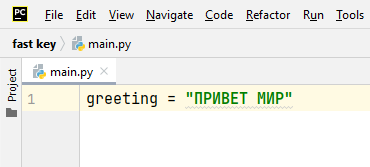 Верхний регистр.
 Нижний регистр.
Быстрое форматирование кода по стандарту PEP 8
Скопированный код с сайта чаще всего требует форматирования, особенно это касается отступов, вручную это делать долго и нудно, поэтому существует команда Ctrl + Alt + L, она в миг исправит все ошибки форматирования в коде и расставит все по своим местам.
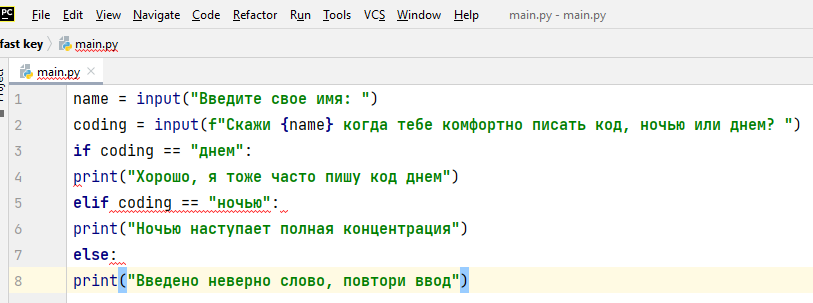 До форматирования.
 После форматирования.
Закомментировать код
Очень полезное и всеми любимое сочетание клавиш быстрого закомментирования текста, выручает, когда закомментировать часть кода чтобы избежать его выполнения Ctrl + /.
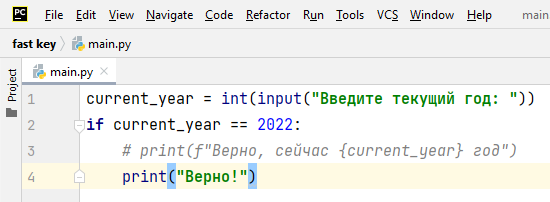
Серым цветом обозначен закомментированный текст.
Табуляция
Некоторые конструкции, например такие как if, elif, else требуют обозначения вложенности (отступов), т.е. после условия нужно отступить от левого края нажав кнопку пробел на четыре раза. Такой ввод можно заменить, нажав один раз кнопку Tab. Обратная команда Shit + Tab, убирает отступ.

Пример табуляции на третьей строчке кода.
Дублирование строки
Быстро продублировать строку поможет сочетание клавиш Ctrl + D.
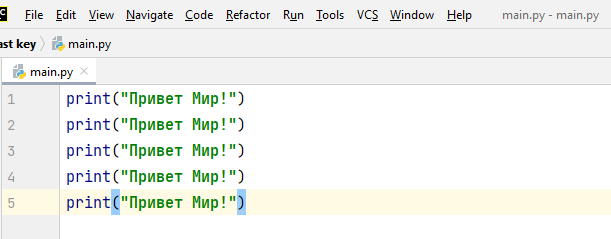
Пример дублирования строк.
Перемещение блоков
Для быстрого перемещения строк или блоков используйте сочетание клавиш Ctrl + Shift + Стрелка вверх – двигает выделенный блок или строку вверх, Ctrl + Shift + Стрелка вниз – двигает выделенный блок или строку вниз.
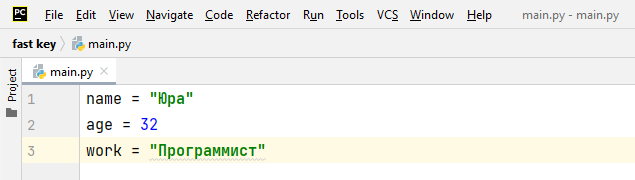 До перемещения.
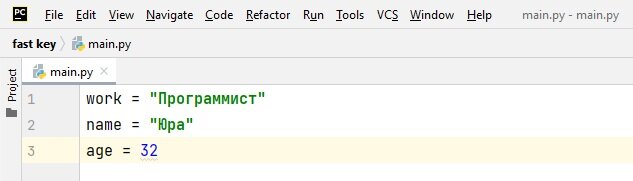 После перемещения.
Выделить текущий блок
При помощи сочетания клавиш Ctrl + W, можно выделить текущий блок, если нажимать это сочетание дальше, то будут выделяться родительские блоки.
 До выделения.
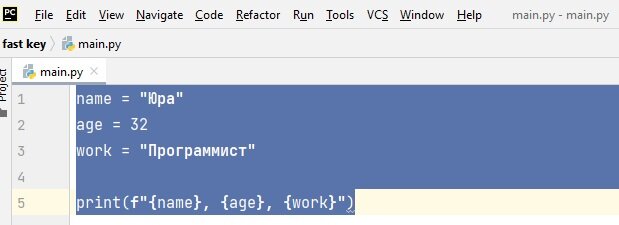 После выделения.
Посмотреть определение методов, функций, переменных и т.п.
Если зажать Ctrl и кликнуть например на переменную, то мы попадем в блок кода где эта переменная определена.
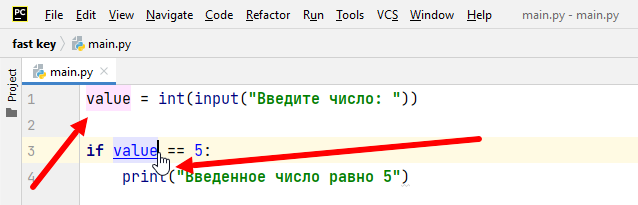
На данном примере кликнув с зажатой клавишей Ctrl на переменную value, мы попадаем в место где она определена.
Показ последних блоков кода с которыми работали
Весьма пригодная команда, для вызова ее используйте комбинацию клавиш Ctrl + Shift + E.
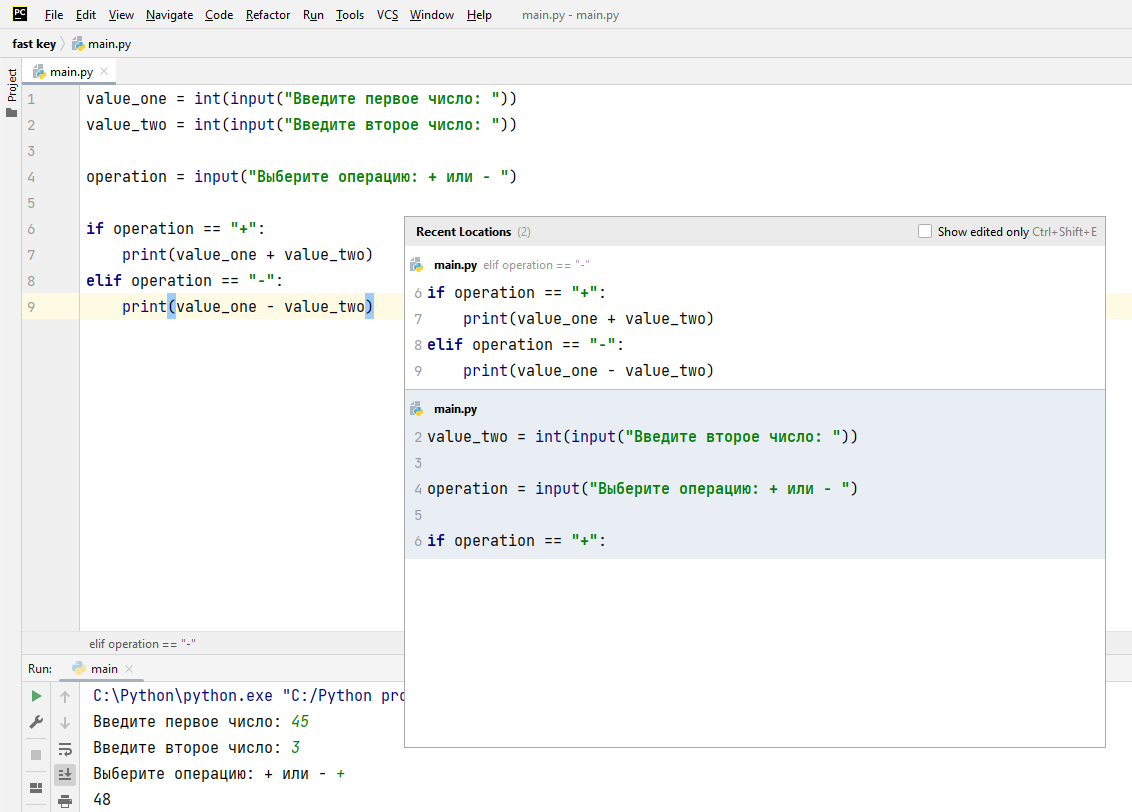
Недавние блоки кода с которыми работали.
Установка и управление закладками
Для того чтобы установить закладку на строке кода, используйте сочетание клавиш Ctrl + F11, откроется меню в котором можно будет выбрать в качестве имени закладки как цифру, так и букву. Быстро установить безымянную закладку поможет клавиша F11, открыть меню с закладками можно при помощи сочетания клавиш Alt + 2.
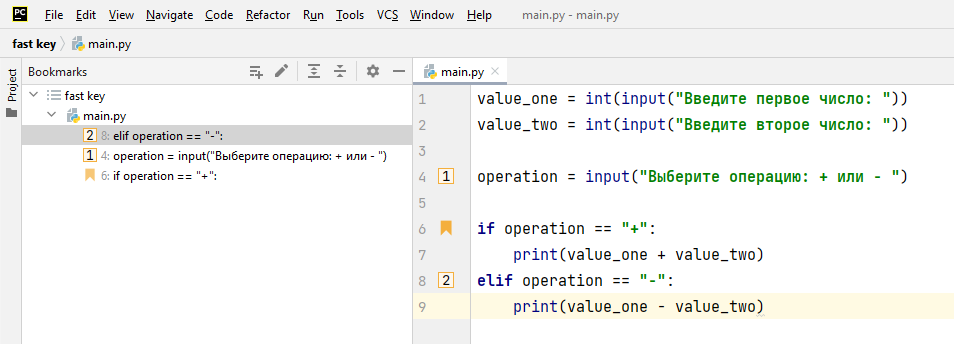
Установка закладок с открытым меню.
А какие горячие клавиши в PyCharm знаете вы? Поделитесь ими в комментариях.
Python – How to delete tabs in pycharm
Im refactoring the code and want to delete tabs in almost hundred of line. It's python. To illustrate what I want to do here is initial code:
Here I want to get this:
Is it possible to do it in pycharm cause manually it takes a lot of time?
Best Solution
Ignoring your function issue that others have mentioned in the comments, unindenting/untabbing many lines of codes can be done in PyCharm by highlighting the text and pressing shift + tab .
For interest, highlighting and pressing tab alone, adds a tab/indent.
Related Solutions
Python – How to merge two dictionaries in a single expression (taking union of dictionaries)
How can I merge two Python dictionaries in a single expression?
For dictionaries x and y , z becomes a shallowly-merged dictionary with values from y replacing those from x .
In Python 3.9.0 or greater (released 17 October 2020): PEP-584, discussed here, was implemented and provides the simplest method:
In Python 3.5 or greater:
In Python 2, (or 3.4 or lower) write a function:
Explanation
Say you have two dictionaries and you want to merge them into a new dictionary without altering the original dictionaries:
The desired result is to get a new dictionary ( z ) with the values merged, and the second dictionary's values overwriting those from the first.
A new syntax for this, proposed in PEP 448 and available as of Python 3.5, is
And it is indeed a single expression.
Note that we can merge in with literal notation as well:
It is now showing as implemented in the release schedule for 3.5, PEP 478, and it has now made its way into the What's New in Python 3.5 document.
However, since many organizations are still on Python 2, you may wish to do this in a backward-compatible way. The classically Pythonic way, available in Python 2 and Python 3.0-3.4, is to do this as a two-step process:
In both approaches, y will come second and its values will replace x 's values, thus b will point to 3 in our final result.
Not yet on Python 3.5, but want a single expression
If you are not yet on Python 3.5 or need to write backward-compatible code, and you want this in a single expression, the most performant while the correct approach is to put it in a function:
and then you have a single expression:
You can also make a function to merge an arbitrary number of dictionaries, from zero to a very large number:
This function will work in Python 2 and 3 for all dictionaries. e.g. given dictionaries a to g :
and key-value pairs in g will take precedence over dictionaries a to f , and so on.
Critiques of Other Answers
Don't use what you see in the formerly accepted answer:
In Python 2, you create two lists in memory for each dict, create a third list in memory with length equal to the length of the first two put together, and then discard all three lists to create the dict. In Python 3, this will fail because you're adding two dict_items objects together, not two lists —
and you would have to explicitly create them as lists, e.g. z = dict(list(x.items()) + list(y.items())) . This is a waste of resources and computation power.
Similarly, taking the union of items() in Python 3 ( viewitems() in Python 2.7) will also fail when values are unhashable objects (like lists, for example). Even if your values are hashable, since sets are semantically unordered, the behavior is undefined in regards to precedence. So don't do this:
This example demonstrates what happens when values are unhashable:
Here's an example where y should have precedence, but instead the value from x is retained due to the arbitrary order of sets:
Another hack you should not use:
This uses the dict constructor and is very fast and memory-efficient (even slightly more so than our two-step process) but unless you know precisely what is happening here (that is, the second dict is being passed as keyword arguments to the dict constructor), it's difficult to read, it's not the intended usage, and so it is not Pythonic.
Here's an example of the usage being remediated in django.
Dictionaries are intended to take hashable keys (e.g. frozenset s or tuples), but this method fails in Python 3 when keys are not strings.
From the mailing list, Guido van Rossum, the creator of the language, wrote:
I am fine with declaring dict(<>, **<1:3>) illegal, since after all it is abuse of the ** mechanism.
Apparently dict(x, **y) is going around as "cool hack" for "call x.update(y) and return x". Personally, I find it more despicable than cool.
It is my understanding (as well as the understanding of the creator of the language) that the intended usage for dict(**y) is for creating dictionaries for readability purposes, e.g.:
Response to comments
Despite what Guido says, dict(x, **y) is in line with the dict specification, which btw. works for both Python 2 and 3. The fact that this only works for string keys is a direct consequence of how keyword parameters work and not a short-coming of dict. Nor is using the ** operator in this place an abuse of the mechanism, in fact, ** was designed precisely to pass dictionaries as keywords.
Again, it doesn't work for 3 when keys are not strings. The implicit calling contract is that namespaces take ordinary dictionaries, while users must only pass keyword arguments that are strings. All other callables enforced it. dict broke this consistency in Python 2:
This inconsistency was bad given other implementations of Python (PyPy, Jython, IronPython). Thus it was fixed in Python 3, as this usage could be a breaking change.
I submit to you that it is malicious incompetence to intentionally write code that only works in one version of a language or that only works given certain arbitrary constraints.
dict(x.items() + y.items()) is still the most readable solution for Python 2. Readability counts.
My response: merge_two_dicts(x, y) actually seems much clearer to me, if we're actually concerned about readability. And it is not forward compatible, as Python 2 is increasingly deprecated.
<**x, **y>does not seem to handle nested dictionaries. the contents of nested keys are simply overwritten, not merged [. ] I ended up being burnt by these answers that do not merge recursively and I was surprised no one mentioned it. In my interpretation of the word "merging" these answers describe "updating one dict with another", and not merging.
Yes. I must refer you back to the question, which is asking for a shallow merge of two dictionaries, with the first's values being overwritten by the second's — in a single expression.
Assuming two dictionaries of dictionaries, one might recursively merge them in a single function, but you should be careful not to modify the dictionaries from either source, and the surest way to avoid that is to make a copy when assigning values. As keys must be hashable and are usually therefore immutable, it is pointless to copy them:
Coming up with contingencies for other value types is far beyond the scope of this question, so I will point you at my answer to the canonical question on a "Dictionaries of dictionaries merge".
Less Performant But Correct Ad-hocs
These approaches are less performant, but they will provide correct behavior. They will be much less performant than copy and update or the new unpacking because they iterate through each key-value pair at a higher level of abstraction, but they do respect the order of precedence (latter dictionaries have precedence)
You can also chain the dictionaries manually inside a dict comprehension:
or in Python 2.6 (and perhaps as early as 2.4 when generator expressions were introduced):
itertools.chain will chain the iterators over the key-value pairs in the correct order:
Performance Analysis
I'm only going to do the performance analysis of the usages known to behave correctly. (Self-contained so you can copy and paste yourself.)
How to delete tabs in pycharm
Im refactoring the code and want to delete tabs in almost hundred of line. It’s python. To illustrate what I want to do here is initial code:
Here I want to get this:
Is it possible to do it in pycharm cause manually it takes a lot of time?
2 Answers 2
Ignoring your function issue that others have mentioned in the comments, unindenting/untabbing many lines of code can be done in PyCharm by highlighting the text and pressing shift + tab .