Which is the suitable database for storing a large JSON? [closed]
We don’t allow questions seeking recommendations for books, tools, software libraries, and more. You can edit the question so it can be answered with facts and citations.
Closed 4 years ago .
I have only one large JSON file. For example,
I need to support operations following operations:
Querying for an element should return all child elements e.g. Querying for AssetID should return
Update value of elements.
I considered following approaches:
- Graph database : I started reading about Neo4J. However, it can not create graph from JSON intellgently. One has to specify node type and their hierarchy order.
- ElasticSearch : It can work by treating JSON as text and hence not efficient solution.
- Postgres : It supports querying over JSON objects but updating, deletions won’t be efficient.
Is there any good database out there which can load data from large JSON and handle my operations?

4 Answers 4
If you are only working with JSON then you should really use a document oriented database as it will save you having to wrestle something sql related.
MongoDB is a good choice, supports many drivers and can deal with tree structures (Though I’m not sure about the automatic creation)
CRUD operations are simple and cover a wide range of cases.
For very large datasets on busy servers you should use the XFS file system and the WiredTiger storage engine as there are some gains in performance.
It’s well supported, and isn’t that much of a learning curve. (I came from Pure SQL without too much trouble)
You also have the option of MariaDB or MySQL which also both support JSON though I have no experience with either, and in the case of MySQL I feel it was just a ‘bolt on’ which had to be added in the face of an up-coming requirement.
This is a typical architectural question to choose the right database, wherein you have to consider quite a few important aspects such as HA, resiliency, replication, sharding, tools support, maturity, licensing, backup & restore etc.
MongoDB and Couchbase DB are the two most popular and widely used document databases. There is no straight-forward answer to choose one, as you have to do trade-off analysis. I can share my two cents, hopefully this would help you in arriving at the right decision.
Either MongoDB or Couchbase NoSQL document databases can be considered, as json is the first class citizen in both and you get really good options to perform operations using fields.
- MongoDB (CP support out of CAP) prefers consistency over availability whereas couchbase (AP out of CAP) is high available database.
- MongoDB cluster works with master/slave architecture whereas couchbase cluster works with peer-to-peer distribution architecture.
There are many more dimensions to be considered and following links would take you in right direction.
Since, in your particular case you have highlighted that you have only one large file, IMDG (in-memory data grid such as Apache Ignite) based solutions can also be considered with a single node set up.
List of JSON Databases
List of database management systems that support JSON.
Here’s a list of database management systems (DBMS) that support JSON.
MongoDB is also a cross platform NoSQL DBMS, currently supporting Windows, Mac, Solaris, and various Linux distributions at the time of writing.
MongoDB is used by some of the largest companies in the world, including Facebook, Google, Nokia, MTV Networks, Cisco, Forbes, and many more.
Behind the scenes, MongoDB actually stores the JSON documents in a binary-encoded format called BSON. BSON extends JSON through supporting additional data types and to be efficient for encoding and decoding within different languages.
The Couchbase Data Platform includes Couchbase Server and Couchbase Mobile. Both of these are open-source, NoSQL, multi-model, document-oriented database management systems that store JSON documents.
Couchbase refers to its platform as the industry’s first Engagement Database — a new class of database that can tap into dynamic data, at any scale and across any channel or device.
Couchbase (the company) began as NorthScale in 2009, and was subsequently renamed to Membase Incorporated in 2010. Couchbase, Inc. was then created through the merger of Membase and CouchOne in February 2011.
Couchbase customers include Amadeus, AT&T, BD (Becton, Dickinson and Company), Carrefour, Cisco, Comcast, Disney, DreamWorks Animation, eBay, Marriott, Neiman Marcus, Tesco, Tommy Hilfiger, United, Verizon, Wells Fargo, and more.
Apache CouchDB is a document oriented open source database management system that uses JSON natively.
CouchDB was first released in 2005 and later became an Apache Software Foundation project in 2008.
Couch is an acronym for cluster of unreliable commodity hardware.
CouchDB is reportedly used by companies such as Amadeus IT Group, Credit Suisse, npm, and the BBC.
Azure DocumentDB is Microsoft’s multi-tenant distributed database service for managing JSON documents at Internet scale. DocumentDB indexing enables automatic indexing of documents without requiring a schema or secondary indices. DocumentDB is designed to provide real-time consistent queries in the face of very high rates of document updates.
MarkLogic is considered a multi-model NoSQL database for its ability to store, manage, and search JSON and XML documents and semantic data (RDF triples).
MarkLogic was initially based on XML, but has since evolved to natively store JSON documents and RDF triples.
MarkLogic customers include Aetna, BBC, Boeing, Broadridge Financial Solutions, Dow Jones, McGraw Hill Financial, NBC, Wiley, U.S. Army, U.S. Navy.
OrientDB is an open source NoSQL database management system written in Java. It is a multi-model database, supporting graph, document, key/value, and object models, but the relationships are managed as in graph databases with direct connections between records.
OrientDB natively supports HTTP, RESTful protocol, and JSON additional libraries or components.
OrientDB clients include Comcast, Sky, Cisco, Verisign, Ericsson, United Nations, and Warner Music Group.
RethinkDB is the first open-source, scalable JSON database built from the ground up for the realtime web. RethinkDB is designed specifically to push data to applications in realtime.
Riak is a distributed NoSQL key-value data store that offers high availability, fault tolerance, operational simplicity, and scalability. In addition to the open-source version, it comes in a supported enterprise version and a cloud storage version.
Although Riak wasn’t explicitly created as a document store, it does have features that make it possible to store and query JSON objects or XML.
BaseX is a native and light-weight XML database management system and XQuery processor, developed as a community project on GitHub.
Although it’s an XML database, its JSON module contains functions to parse and serialize JSON documents.
Elasticsearch is a search engine based on Lucene. It provides a distributed, multitenant-capable full-text search engine with an HTTP web interface and schema-free JSON documents. Elasticsearch is developed in Java and is released as open source under the terms of the Apache License. Elasticsearch is the most popular enterprise search engine followed by Apache Solr, also based on Lucene.
Elasticsearch users include Wikimedia, Adobe Systems, Facebook, Stack Exchange, Quora, Mozilla, Netflix, and more.
MySQL is the world’s most popular open source DBMS. MySQL is used by some of the largest organisations in the world, including Facebook, Google, Twitter, Adobe, Flickr, Alcatel Lucent, Zappos, YouTube, and many more. It is also used by many smaller scale projects such as personal websites or blogs.
MySQL 5.7.8 introduced a native JSON data type that enables efficient access to data in JSON. This includes optimized storage, and automatic validation of JSON documents stored in JSON columns. Invalid JSON documents will produce an error.
Oracle Database is an object-relational database management system produced and marketed by Oracle Corporation. Oracle Database is one of the world’s most popular RDBMSs.
Although Oracle Database is an object-relational database, it does support JSON (and XML). It supports JSON natively with relational database features, including transactions, indexing, declarative querying, and views.
PostgreSQL (often referred to as Postgres), is an object-relational database management system (ORDBMS) with an emphasis on extensibility and standards-compliance.
PostgreSQL also has a number of JSON functions and operators that can be used with its two JSON data types (JSON, and JSONB).
Why NoSQL JSON Databases Are So Useful
My family hears me talk about JSON databases rather frequently.
Naturally, I had to explain that Jason is not the owner of my company! Instead, many modern databases use JSON as a data format. They usually leave the room at this point, tired of indulging my enthusiasm for the Couchbase JSON database.
What Is a JSON Database?
A JSON database is arguably the most popular category in the NoSQL family of databases. NoSQL database management differs from traditional relational databases that struggle to store data outside of columns and rows. Instead, they flexibly adapt to a wide variety of data types, changing application requirements and data models. In an era where physical storage limits are no longer a bottleneck, JSON databases deliver superior scale and performance.
This flexibility made JSON databases the preeminent storage structure for NoSQL systems that support multi-model or multi-modal processing. Their popularity is due mainly to the simplicity and flexibility of the JSON database document structure.
First introduced in 2006, JSON stands for “JavaScript Object Notation” and offers a less verbose data format than the popular XML (eXtensible Markup Language). Today the JSON data format is powering enterprise systems around the globe despite its humble roots in enabling JavaScript programming and simple web-based applications. JSON databases like Couchbase or MongoDB take advantage of the standard’s simple syntax, providing data structures readable by both humans and machines.
Let’s look at some of the advantages of a database that stores data in JSON format. While we do, consider how you might be able to leverage its functionality in future applications.
JSON Databases Have More Storage Flexibility
NoSQL is a database category adapted to specific use cases that focus on storage structure, scaling design and query/indexing methods. There is also a focus on concurrency, high availability and real-time data persistence guarantees.
For example, some databases optimize key-value data storage for retrieval speed – aiming to run as fast as possible. They often run primarily in memory, avoiding the time-consuming burden of reading data from spinning hard drives.
Of course, memory is volatile and power failures can erase data stored in memory. Key-value database engines offer a means for writing data to persistent storage to reduce data loss. However, key-value stores may be too simplistic for some use cases.
In addition, other data structures, such as graph databases, may be too abstract for other use cases. Graph database structures can be fast, as they usually support in-memory processing to expedite relationship traversal speeds. However, to do this requires a natively built data architecture with fancy design names like “index-free adjacency.” These structures associate each piece of data with a set of relationship ID numbers stored physically on a disk.
Graph data models were most helpful when memory and disk space were scarce. But it created challenges when scaling a graph structure across multiple database nodes. For example, where do you logically break your relationships in the underlying data?
NoSQL JSON databases handle documents as individual data file objects without using structured tables. A row count or table size does not constrain the number of documents stored in a JSON database. Instead, storage availability is the only limit to data volume. Thankfully, a cluster can easily expand storage.
Partitioning Data
This cluster-based approach allows the database to add more nodes to create a larger data platform as needed. Developers also call this process “scaling out” the cluster. Partitioning data across nodes allows distributed storage and processing where no single node is doing all the work.
The underlying database partitions the data to maintain this balance using a pool of storage services in a shared-nothing architecture. The system balances and replicates data to keep it available if a node becomes unusable.
Processing Data Models
A cluster can also have a mix of node types – data storage, processing, and serving data – using different access models. A JSON database makes it possible to store data as JSON and provide it to applications in other forms.
For example, JSON databases can operate as an in-memory key-value store for applications that just need quick and easy access. Or, indexing and querying can make JSON data appear as a table. Also, developers can use data structure SDKs to serve up atomic attributes as key-value pairs.
JSON Databases Offer Flexible Schemas
JSON document databases store their data in files using a specific notation designed to eliminate the rigidity of relational database schemas. They can more rapidly meet new data structure requirements derived after the initial database schema design and application release.
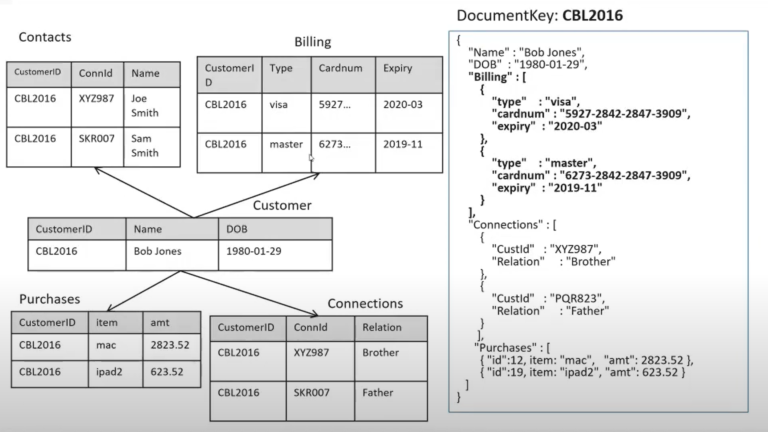
Comparison of a multi-table relational data model to a simplified JSON document.
In the 80s and 90s, application maintenance and delivery cycles often took years to complete. And one of the most time-consuming and dreaded exercises was introducing new database schema changes underneath an application.
Now, developers can add new attributes to a document, essentially extending the schema of that document. With the power of JSON databases, developers control the schema, not the DBA.
For example, when building a document that describes a person, the developer can add and modify attributes as needed. The developer can extend a document that only stored a first and last name to include a home address. Schema flexibility is why developers like JSON databases and Couchbase customer surveys prove that.
JSON databases have a modern advantage as cloud-based infrastructures have commoditized physical storage costs (and RAM to a lesser extent). So ultimate compactness is not as critical as it used to be. Additionally, organizing documents in a JSON database is much more intuitive than relational and other structures.
JSON Data Is Easy to Read
Data in a JSON database is easy to read and write for both people and machines due to its simplicity.
Like JavaScript, documents contain sets of key names associated with attributes or objects. Using white space can make documents more readable for humans.
JSON Databases Explained
JSON (JavaScript Object Notation) has become a standard data-interchange format, particularly for semi-structured data. JSON databases are part of the NoSQL family of databases that offer flexibility in storing varied data types and easily accommodating changes in data model or project requirements. The flexibility of a JSON database comes from the way data is stored—as documents instead of rigid tables. Read on to know more.
What are JSON databases?
A JSON database is a document-type NoSQL database, ideal for storing semi-structured data. It’s much more flexible compared to the row-columns format, which is fixed and expensive when it comes to implementing even small schema changes.
With relational databases, JSON data needs to be parsed or stored using the NVARCHAR column (LOB storage). However, document databases like MongoDB can store JSON data in its natural format, which is readable by humans and machines.
There are two ways to store JSON data in a JSON database:
Store the whole object in a single document.
Here, the author details are inside the book document itself. This technique is also known as embedding because the author subdocument is embedded in the book document.
Store parts of objects separately and link them using the unique identifiers (referencing).
One author may write multiple books. So, to avoid duplicating data inside all the books, we can create separate author document and refer to it by its _id field:
Advantages of JSON databases
Just like traditional databases, JSON document databases manage data partitioning, indexing, clustering, replication, and data access on their own. Apart from this, JSON databases offer many advantages.
JSON databases are faster and have more storage flexibility
NoSQL databases, in general, have more storage flexibility and offer better indexing methods. In a document database, each document is handled as an individual object, and there is no fixed schema, so you can store each document in the way it can be most easily retrieved and viewed. Additionally, you can evolve your data model to adapt it to your changing application requirements. The schema versioning pattern makes use of the flexible document model to allow just that.
JSON databases provide better schema flexibility
The best part of a JSON document database is the schema flexibility—i.e., it supports whatever way you want to store your data. You can have all the information that you need to access together (embedding) in one document or take the liberty of creating separate documents and then linking them (referencing). It’s very simple to even query the nested objects inside a document, like nested arrays or embedded documents.
JSON databases can easily map to SQL structures
Many developers are familiar with SQL. By storing data in a JSON database, developers can simply map SQL columns and JSON document key names. For example, the bookName key of a document can be mapped to the book_name column of the book table. Most JSON databases automate this mapping, which saves on a developer’s learning curve and reduces the development time.
JSON databases support different index types
Due to the availability of various index types, search queries are quite fast. For example, since MongoDB has no fixed schema, you can create a wildcard index on a field or set of fields to support querying that field. There are many other types of indexes, like O2-tree and T-tree, that make NoSQL databases highly performant.
JSON databases are better suited for big data analytics
JSON databases have a flexible schema and scale well vertically and horizontally, making them suitable to store huge volumes and a variety of big data. Document databases like MongoDB have a rich query language (MQL) and aggregation pipeline, eliminating the need for ETL systems for data processing and transformation. Further, these databases can easily pass data to popular data analysis programming languages like Python and R, without additional coding steps.