Python: Convert true to 1 and false to 0
Write a Python program to convert true to 1 and false to 0.
Sample Solution:-
Python Code:
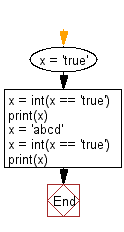
Flowchart:
Visualize Python code execution:
The following tool visualize what the computer is doing step-by-step as it executes the said program:
Python Code Editor:
Have another way to solve this solution? Contribute your code (and comments) through Disqus.
What is the difficulty level of this exercise?
Test your Programming skills with w3resource’s quiz.
Follow us on Facebook and Twitter for latest update.
Python: Tips of the Day
You can turn a set into an immutable set
This way, you can no longer modify it:
If you do that, an error will be thrown:
- Weekly Trends
We are closing our Disqus commenting system for some maintenanace issues. You may write to us at reach[at]yahoo[dot]com or visit us at Facebook
Python | Ways to convert Boolean values to integer
Given a boolean value(s), write a Python program to convert them into an integer value or list respectively. Given below are a few methods to solve the above task.
Convert Boolean values to integers using int()
Converting bool to an integer using Python typecasting.
Python3
Output:
Time Complexity: O(1)
Auxiliary Space: O(1)
Convert Boolean values to integers using the Naive Approach
Converting bool to an integer using Python loop.
Python3
Output:
Convert Boolean values to integers using NumPy
In the case where a boolean list is present.
Python3
Output:
Convert Boolean values to integers using map()
In a case where a boolean list is present.
Python3
Output:
Using List comprehension
This approach uses list comprehension to iterate through the list ‘bool_val’ and applies the int() function to each element, which converts the Boolean value to its integer equivalent (1 for True and 0 for False).
Python true false to 0 1 | Convert bool example code
In Python True and False are equivalent to 1 and 0. Use the int() method on a boolean to get its int values.
Output:

int() turns the boolean into 1 or 0.
Note: that any value not equal to ‘true’ will result in 0 being returned.
Ways to convert Boolean values to integer 0 1 in Python
Python program to convert given a boolean value into an integer value 0 and 1
Using int() method
Output:

Naive Approach
Output: 1
numpy boolean list
Output: [1 0]
Using map() Method
Convert boolean list values into a 0 1.
Output: [1, 0]
Python boolean addition
Since bool is a subclass of int, it can be calculated like integers.
Output:
Count the number
the list of True and False using the built-in function sum() which calculates the sum of the numbers stored in the list.
Output: 2
Do comment if you have any doubts and suggestions on this Python true false topic.
Note: IDE: PyCharm 2021.3.3 (Community Edition)
Windows 10
Python 3.10.1
All Python Examples are in Python 3, so Maybe its different from python 2 or upgraded versions.
Convert Boolean Values to Integer in Python
This tutorial will discuss converting boolean values to integers in Python.
Convert Boolean Values to Integer Using the if/else Block in Python
In Python, the boolean values True and False correspond to integer values 1 and 0, respectively.
We can write a user-defined function that returns 1 if the value passed to the function is True and 0 if the value passed to the function is False .
We can do this by just the if/else block. The following example code shows us how to convert Boolean values into 0 or 1 using the if/else statement.
Convert Boolean Values to Integer Using the int() Function in Python
The int() function takes the boolean value as an input and returns its equivalent integer value. We can drastically reduce the code size in the previous example with int() .
The code snippet demonstrates the use of the int() function to convert a boolean value into 1 or 0 in Python.
We converted the values True and False into integers 1 and 0, respectively, with the int() function and stored the integer values inside variables x and y . We displayed the values in the output.
Convert Boolean List to Integer Using the map() Function in Python
The previous sections discussed the methods to convert only a single boolean value to an integer value in Python. Now, we’ll see how to convert a list of boolean values into their equivalent integer values with the map() function.
The map() function requires a function and a list of arguments as input parameters. It applies that function on each element of the list and returns the output of that function.
The code below shows us how to convert a list of boolean values into a list of integers with the map() function in Python.
We converted the list of boolean values boo into a list of integer values by using the int() function inside the map() function. We enclosed the map() function inside the list() function to convert the output returned into a list.
In the end, we printed the newly generated list of integers.
Convert True / False String to Integer With the int() Function in Python
In the previous sections, we’ve discussed the methods to convert boolean values into integer values. This section will discuss the scenario where we have to convert a string value into 1 or 0.
We can utilize the int() function discussed in the previous sections to handle this problem.
Let’s consider an example to convert the string true to 1 and false to 0. We know from the previous discussions that the int() function converts the boolean arguments into equivalent integer values.
We can convert this string into a boolean value with the == operator and pass it to the int() function.
The following code demonstrates a working example of this whole process.
We converted the string variable x into its boolean equivalent integer value 1 by first converting it into a boolean expression with x == ‘true’ and passing that boolean expression to the int() function.
This method will return a False boolean value or 0 integer value for every value of x other than true .
Maisam is a highly skilled and motivated Data Scientist. He has over 4 years of experience with Python programming language. He loves solving complex problems and sharing his results on the internet.