How to set to Ignore Ping Packets from WAN Port
The measurement is realized by sending packets and response. Sending a Ping Packet to the WAN Port of a router, then the router is supposed to respond immediately. If there is no response or a delayed response, it means that the network is interrupted or the internet access is bad.
Why people want to ignore Ping Packets from WAN Port?
1. Ping may burden your CPU and damage network security. Large amount of Ping requests would burden the CPU, making it too busy to deal with common requests, and even block the network. Though Ping itself is used for internet testing, some people may use it to damage the network security, by sending a large amount of Ping Packets in a short time.
2. Ping may make your IP exposed to hackers’ attack. Hackers usually scan the IP addresses from the internet before launching attack. One of the common scanning methods is Ping. If one device respond, it means that the device is active and can be an attacking target. Thus, set to ignore Ping Packets from WAN Port can hide our devices from hackers’ targets.
How to configure?
You can easily turn on the function to ignore Ping Packets from WAN Port via the Web Browser.
Follow the steps below, here takes Archer A7 as demonstration:
Step 1: Log in the manage page by referring
Step 2: Click Advanced>Security>Settings, and find the option Ignore Ping Packet From WAN Port, just click it to check (√) this function!
Step 3: Don’t forget to Save your settings!
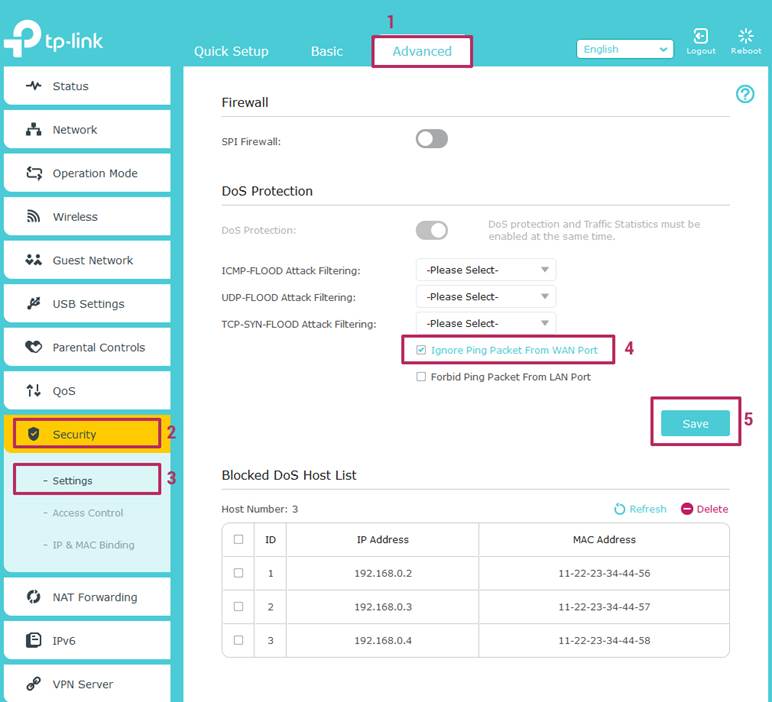
Get to know more details of each function and configuration please go to Download Center to download the manual of your product.
Был ли этот FAQ полезен?
Ваш отзыв поможет нам улучшить работу сайта.
Что вам не понравилось в этой статье?
- Недоволен продуктом
- Слишком сложно
- Неверный заголовок
- Не относится к моей проблеме
- Слишком туманное объяснение
- Другое
Как мы можем это улучшить?
Спасибо
Спасибо за обращение
Нажмите здесь, чтобы связаться с технической поддержкой TP-Link.
Нужна помощь? Задавайте вопросы, находите ответы и обращайтесь за помощью к специалистам TP-Link и другим пользователям со всего мира.
Подписаться на рассылку Мы с ответственностью относимся к вашим персональным данным. Полный текст положения об обработке персональных данных доступен здесь. С нашими условиями использования и программой улучшения пользовательского опыта можно ознакомиться здесь.
how to ping a computer from wan
then i tried to ping 192.168.0.1 <— i think this should be the wifi router’s ip address.
My Question: How do I find the computers connected to the wifi network by using only the WAN IP?
1 Answer 1
As your network is behind NAT, you won’t be able to use a standard PING to each device. The ping utility sends ICMP requests, which will be responded to by a single device when sent to a WAN IP address, usually your NAT gateway (in this case your WiFi router I believe).
This is the intended behaviour, and is one of the fundamental security aspects of NAT, that your local devices are not revealed to a WAN.
How do I find the computers connected to the wifi network by using only the WAN IP?
There are a few options (and I’m sure many more than I will be offering here). To access devices behind a NAT, you can set up servers using specific ports. For example, when you have used telnet from outside of your network, it will be using the default port 23 , which, as you’ve found, your device handling your WAN is listening to and allows communication.
It depends from here what your actual requirement is. If you wish to find out which devices are online, you could set up a server on each, which you could then ‘ping’ on it’s specific port. Your NAT gateway can then port forward each request to the correct LAN device.
Or, you could set up a single server which you could connect into, via something like SSH , which would give you a device inside your network you could then ping each device from using it’s local IP address.
The standard PING utility, as it uses ICMP which doesn’t have a concept of ports, can’t be directed to different machines behind your NAT gateway. You would need to use software that replicated the functionality of PING , but through a protocol like TCP. You’d then use this software in a format such as:
X. WAN
DrayTek Vigor routers have the ability to ensure an Internet connection is in a working state with WAN Connection Detection. This checks the Internet connection for connectivity and if that fails, drops the WAN connection to restart it or use a Failover Backup connection.
It is possible for an Internet connection to remain active but be in a state where it cannot communicate with the Internet.
For instance where an ISP has routing issues that stops access to the Internet, the link between the router and the ISP would still be active. The router would not see a need to stop using that WAN interface and switch to a Backup WAN, because it can still contact the ISP Gateway.
In this scenario, Ping Detection should be used to force the router to check connectivity beyond the ISP with a target remote IP; if it’s unable to ping, the router will drop that Internet connection until it can get a response from that IP again.
The DrayTek Vigor routers have 3 types of configurable WAN Connection Detection available:
| ARP Detection | Sends an ARP request packet to the WAN Gateway, if there is no response within 30 seconds, the router will drop the WAN connection |
| Ping Detection | Sends an ICMP ping packet to the specified IP address(es) and if those addresses do not respond after the configured number of retries, the router will drop the WAN connection |
| Always On | This disables the WAN Connection Detection and limits detection to Physical Link connectivity only. This option is only available for Static IP & DHCP connections |
PPP connections such as PPPoA and PPPoE Internet connections, have an inherent form of link detection called LCP (Link Control Protocol). LCP will drop the PPP connection if the PPP server and Vigor router are unable to communicate using this protocol, the router will allow 3 retries before dropping the connection with an «LCP Timeout».
This table outlines the potential benefits to using the specific WAN Connection Detection methods:
| Connection Issue | Always On | ARP Detection | Ping Detection |
|---|---|---|---|
| Ethernet link disconnection | |||
| ADSL / VDSL link disconnection | |||
| PPPoE / PPPoA disconnection | |||
| Connectivity with ISP Gateway | |||
| Loss of IP Connectivity | |||
| Connectivity to specific IPs / Web sites | |||
| Significant Packet Loss | |||
| Too many hops (TTL) |
Setup & More Information
These settings are configured from the WAN interface settings in [WAN] > [Internet Access] > WAN Details Page for each WAN connection:

WAN Connection Detection methods can be set for all WAN interfaces individually on the router.
Please Note: Some settings shown may not be available on all DrayTek routers or firmware versions. Updating to the latest firmware (currently 3.8.2.3) may provide more configuration options.
ARP Detect

ARP Detection is the default WAN Connection Detection mode on all DrayTek Vigor routers that run DrayOS.
This is designed to check connectivity to the ISP by testing whether the ISP Gateway address gives a response to an ARP request.
The router sends this ARP request every 5 seconds and if there is no response from the ISP Gateway within 30 seconds, the DrayTek router will drop the WAN interface until it begins to receive ARP responses again.
This can be used with all types of WAN interface.
| Disadvantages: |
| Cannot determine whether connection is working beyond the ISP Gateway |
Ping Detect
 Ping Detection is the more advanced of the WAN Connection Detection modes. It is designed to ping one or more target IP addresses. If there’s no response, the WAN connection fails a «WAN Health Check» and the WAN interface goes off-line until the target IP starts responding again.
To display the options shown, select «Ping Detect» as a WAN Connection Detection option.
Ping IP:
The Ping IPs shown here are examples and will not work in a real setup.
The IP address used should be one that gives 100% uptime and responds to pings, for instance:
— IP address of a Web site or Remote site required for normal operations
— Popular Internet DNS servers
To find IPs of hostnames / websites, try this command in a Windows Command Prompt to see which IP addresses are associated with it:
If setting up Ping Detect with the IP address result of a hostname, please note that that IP could change and no longer respond, resulting in the WAN Connection check failing. Setting a Secondary Ping IP to a different location would avoid this issue.
TTL — Time To Live:
The TTL setting controls the number of «hops» allowed between the router and the target IP(s). That is, the number of routers / gateways that the packet passes through.
For instance a TTL of 10, or 10 hops, would pass through 10 different gateways to reach the target IP, which is typical for international traffic.
This can be useful to detect / react to routing issues such as traffic taking a longer than normal path, but if set lower than the required number of hops, would result in the WAN interface going off-line, even though the IP address is responding without issue.
It’s possible to find the number of hops required to reach a site with Trace Route («tracert» in the Windows Command Prompt) but setting a more relaxed value such as 30-100 is recommended to handle normal network routing changes. Setting the highest value of 255 is best when this isn’t necessary.
Ping Interval & Ping Retry:
Setting a high Ping Interval and high number of Ping Retries will increase the amount of time to detect that the WAN connection has failed and make it less sensitive to brief losses of connectivity and packet loss. The default values will send a ping every second and if one ping fails, the router will allow up to 10 more failures before considering the WAN off-line. This results in roughly 15 seconds wait between the first ping failure and the WAN being taken off-line.
Setting a low Ping Interval and low Ping Retry count will make the WAN Connection Detection sensitive to packet loss or brief disconnections and could take the WAN off-line if there is significant packet loss.
Sending a ping every second will use roughly 20MB of data per day, which could be an issue on metered Internet connections (3G / 4G LTE).
It is recommended to tune these settings depending on your requirements.
The configurable options are:
Ping Interval
If your router does not show all of these options, the router will use the defaults specified above.
| Advantages: | Disadvantages: |
| Configurable to meet requirements | Must ping a valid IP address located on the Internet / WAN |
| Responds quickly to lack of connectivity, around 15 seconds by default | If the remote IP does not respond, for instance the remote site is down, the router could take the WAN interface offline |
| Can determine whether ISP Gateway is working | Configuring multiple WANs to check connectivity with the same IP could result in multiple WAN interfaces going offline |
| Can check connectivity to specified remote IPs / locations | Configuring TTL value too low can result in the WAN connection check failing |
| Can detect Routing issues with the TTL setting | Configuring Ping Interval & Retry values too low can make the Internet connection too sensitive to latency or packet loss |
| Setting a low Ping Interval with a low Ping Retry count could potentially detect packet loss on a WAN interface |
Always On
This setting disables the WAN Connection Detection on the router. It is only available for MPoA and Static or Dynamic IP connections, the option will not be visible with PPP connections. When set, the router will only determine WAN state by checking the physical link state, such as whether the network cable is connected or the DSL link is connected.
3 локальное управление – Инструкция по эксплуатации TP-Link TL-WR841N V8

Включить фильтрацию UDP-FLOOD – Включение/Выключение фильтрации
UDP-FLOOD.
Порог пакетов UDP-FLOOD UDP-FLOOD (5
3600) — Значение по умолчанию 500.
Укажите значение в пределах 5
3600. Если текущее значение ниже установленного,
маршрутизатор немедленно активирует функцию блокировки.
Включить фильтрацию от атак TCP-SYN-FLOOD – Включение/Выключение
фильтрации TCP-SYN-FLOOD атак.
Порог пакетов TCP-SYN-FLOOD (5
3600) — Значение по умолчанию 50. Укажите
значение в пределах 5
3600. Если текущее значение ниже установленного,
маршрутизатор немедленно активирует функцию блокировки.
Игнорировать Ping-пакеты от порта WAN — Включение/Выключение функции
игнорирования Ping-пакетов от порта WAN. По умолчанию функция отключена. При
включенной функции Ping-пакетам из Интернет отказывается в доступе к
маршрутизатору.
Запретить Ping-пакеты от порта LAN — Разрешить/Запретить Ping-пакеты от порта
LAN. По умолчанию функция отключена. При включенной функции Ping-пакетам
отказывается в доступе к маршрутизатору. Функция используется для защиты от
некоторых типов вирусов.
Сохранить, чтобы сохранить сделанные изменения.
Список заблокированных DoS-узлов, вы перейдете в таблицу
узлов-источников DoS-атак для проведения операций блокирования.
4.9.3 Локальное управление
Безопасность — Локальное управление, вы можете настроить правила
управления в окне, представленном на Рис. 4-42. Функция управления позволяет
блокировать доступ компьютеров локальной сети к маршрутизатору.